

Silverado 1500 Service and Maintenance Schedule
Silverado 1500 Service and Maintenance Schedule
The Silverado maintenance schedule is one of those things that buyers ask about after the purchase more than before it, and that timing works against them.
At Barry’s Chevrolet in West Union, Ohio, we service Silverados for buyers across Adams County and Southern Ohio, and the pattern we see consistently is this: trucks that were maintained on schedule run reliably for 200,000 miles and beyond. Trucks that were not start showing expensive problems much earlier. This page covers the complete Silverado 1500 service schedule, what each item does, and why the severe duty intervals matter for most buyers in this region.
Silverado 1500 Maintenance Schedule
*Severe duty conditions include: towing a trailer regularly, carrying heavy loads, operating on gravel or unpaved roads, operating in extreme temperatures, or making frequent short trips. If your truck does any of these, use the severe duty column.
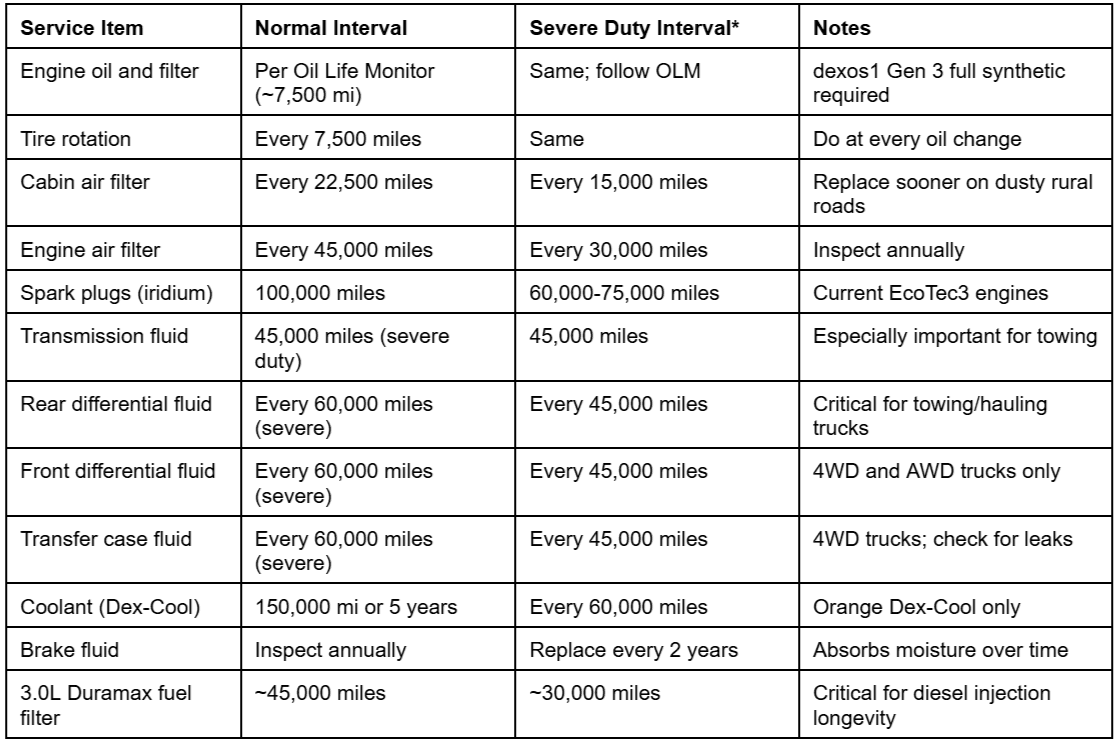
The intervals above are based on current GM maintenance recommendations. Always confirm specific intervals for your model year in the owner’s manual. Intervals may vary slightly by engine type and production year.
Why Most Southern Ohio Silverado Owners Are on Severe Duty
GM’s severe duty definition covers towing, hauling, gravel roads, extreme temperatures, and frequent short trips. For buyers in Adams County and across Southern Ohio, that is not an exception category. It is the normal use pattern.
Pulling a livestock trailer to the sale barn in Hillsboro is towing. Driving gravel farm lanes to check cattle is rough roads. Running a loaded construction trailer to jobs across Adams County is hauling. Starting the truck in the cold for a short drive to the hardware store and back is frequent short trips in extreme temperatures.
Most Silverado owners in this region are in severe duty conditions multiple days per week. The normal service intervals are not the right reference point. Use the severe duty column. It costs you a few extra service appointments per year and saves you from discovering that deferred maintenance created a $3,000 repair when you were expecting a $60 oil change.
Oil Changes: The Non-Negotiable
Oil changes are the most important single maintenance item on any Silverado, and they are specifically critical for trucks with the EcoTec3 5.3L or 6.2L V8. The Active Fuel Management (AFM) system on 2014-2021 trucks and the Dynamic Fuel Management (DFM) system on 2022-present trucks put higher demand on oil quality than a simple naturally aspirated engine without cylinder deactivation. Degraded oil that has run past its service life does not protect the AFM or DFM lifters adequately.
GM specifies dexos1 Gen 3 full synthetic oil for the current EcoTec3 engines. This is not a suggestion. Using oil that does not meet the dexos1 Gen 3 specification can affect warranty coverage for engine concerns. When you bring your Silverado in for an oil change at Barry’s, we use the correct oil.
Follow the Oil Life Monitor in the instrument cluster. Do not add miles to squeeze more out of an interval. When the monitor reaches 0%, the oil is at the limit of its useful service life for your specific driving conditions. Reset the monitor after every change.
Tire Rotation and the Tire Monitor System
Tire rotation at every oil change interval keeps front and rear tires wearing at similar rates, extends the life of the tire set, and prevents the handling changes that come from significant front-to-rear wear differences.
On AWD and 4WD Silverados, maintaining even tire wear across all four wheels is particularly important. Significant diameter differences between front and rear tires can stress the transfer case and AWD system components.
What Does “Service Tire Monitor System” Mean on a Silverado?
This is one of the most commonly searched Silverado service questions, and the answer is simpler than the warning message suggests. The Tire Pressure Monitoring System (TPMS) on your Silverado watches tire pressure in each wheel. The “Service Tire Monitor System” message appears when the TPMS sensors need attention: typically when a sensor battery is low or a sensor has failed, or when the system needs to be reset after tire service.
It does not necessarily mean a tire is flat or low. It means the monitoring system itself needs service. At Barry’s, we can diagnose which sensor is the issue and address it. If all four tires are properly inflated and the message appears, bring it in for a TPMS diagnostic rather than assuming there is a tire pressure problem.
The related but separate warning is the low tire pressure light (the horseshoe icon). That warning means one or more tires is actually low on pressure. Check the pressure on all four tires when that light comes on.
Transmission and Drivetrain Fluids
Transmission fluid is the most commonly deferred major service item on working trucks, and it is the one with the most expensive consequences when it is ignored for too long.
GM designates the Silverado transmission as a lifetime fill under normal conditions. For most working truck owners in Southern Ohio who tow and haul regularly, the severe duty interval of 45,000 miles is the relevant number. Transmission fluid that has absorbed heat cycles from towing on Southern Ohio grades is not in the same condition as fluid from a flat highway commuter.
Rear and front differential fluids, and the transfer case fluid on 4WD trucks, are similarly important and similarly deferred. These are not glamorous service items and they do not trigger warning lights when they are due. They just wear quietly until the differential or transfer case starts showing damage. Service them at the severe duty intervals and you will not find out what happens when you do not.
The Silverado 4WD Service Message
“Service 4WD” is a warning message that appears on some Silverado trucks when the 4WD system detects an issue. Common causes include transfer case or encoder motor problems, a faulty mode switch, or an issue with the front axle engagement components. It can also appear after a battery replacement or electrical work that clears the system memory.
The Service 4WD message should be diagnosed rather than ignored. Drive in 2WD until it is addressed. A 4WD system fault can leave you without 4WD capability when you need it, and deferred diagnosis can allow a minor issue to develop into a major one. Bring it in to Barry’s and we will pull the codes and tell you what the system is flagging.
Cooling System
The Silverado uses Dex-Cool orange antifreeze. Do not mix it with green conventional antifreeze. If the cooling system was topped up with a different coolant at any point, have the system flushed and refilled with the correct coolant before the mixed fluid causes sludge buildup in the cooling passages.
Healthy Dex-Cool is a clear orange. If the coolant in the reservoir looks brown, rusty, or cloudy, it has either been mixed with incompatible coolant, contaminated, or is overdue for service. Cooling system problems on a diesel truck are particularly expensive to address if allowed to develop.
Diesel-Specific Maintenance: 3.0L Duramax
Silverado owners with the 3.0L Duramax inline-6 diesel have additional maintenance requirements beyond the standard items:
- Fuel filter: the most critical diesel-specific maintenance item. Change at approximately 45,000 miles under normal conditions and 30,000 miles under severe duty. A restricted or contaminated fuel filter accelerates wear on the high-pressure injection system. Replacement injectors are expensive. A fuel filter is not.
- Diesel exhaust fluid (DEF): top up when the level gets low. The truck will alert you well in advance. Use quality DEF from a reputable source. Low-quality or diluted DEF can damage the dosing injector and after-treatment catalyst. These are expensive repairs that a correct DEF quality prevents.
- Oil specification: the 3.0L Duramax requires dexos D certified diesel oil. This is a different specification from the dexos1 Gen 3 used in the gas engines. Do not use the wrong oil.
Spark Plugs: 100,000 Miles Is Not a Suggestion to Wait
The current EcoTec3 engines use iridium spark plugs rated for 100,000 miles. For most owners in normal driving conditions, that interval is accurate. For owners who tow regularly, operate in extreme conditions, or use the truck in hard commercial applications, replacing plugs at 60,000-75,000 miles is the better choice.
Worn spark plugs affect combustion efficiency, can cause rough running, and on the turbocharged TurboMax 4-cylinder, worn plugs increase the load on the ignition system under boost. Plugs are inexpensive relative to the diagnostic cost of chasing a misfire that could have been prevented.
What Barry’s Service Covers
Barry’s Chevrolet runs a GM-certified service department in West Union, Ohio. We use GM-specification parts and dexos-certified fluids. Our technicians are trained on current and previous generation Silverado trucks. We handle oil changes, tire rotations, all scheduled maintenance milestones, warranty work, recall service, transmission service, differential service, brake and suspension work, and engine maintenance for Silverado owners across Adams County and Southern Ohio.
We are open Saturdays for service, which most dealers in this part of Southern Ohio are not. For buyers who work Monday through Friday, Saturday service is a practical difference. Every oil change at Barry’s includes a tire rotation, full fluid check, and free car wash.
Frequently Asked Questions
How often should I change the oil on my Silverado?
Follow the Oil Life Monitor in the instrument cluster. For most Silverado owners using GM dexos1 Gen 3 full synthetic oil, this works out to approximately 7,000-8,000 miles under normal conditions. Owners who tow, haul, or operate in severe conditions will see shorter intervals. Do not extend past the monitor’s recommendation.
What oil does a 2025 or 2026 Silverado 1500 take?
The EcoTec3 V8 and TurboMax gas engines require GM dexos1 Gen 3 full synthetic oil. The 3.0L Duramax diesel requires dexos D certified diesel oil. Check the owner’s manual for the correct viscosity grade for your specific engine and climate conditions.
What does “Service Tire Monitor System” mean on a Silverado?
This message indicates the tire pressure monitoring system itself needs attention, typically due to a sensor with a low battery or a system reset requirement. It does not necessarily mean a tire is low on pressure. Check all four tire pressures first, and if they are correct, have the TPMS system diagnosed at Barry’s to identify which sensor needs attention.
How often should I service the transmission on my Silverado?
For owners who tow or haul regularly, use the severe duty interval of 45,000 miles for transmission fluid service. GM designates the transmission as a lifetime fill under normal conditions, but most working truck owners in Southern Ohio are in severe duty use patterns that justify the 45,000-mile service interval.
When is the 5.3L V8 spark plug replacement interval?
100,000 miles under normal conditions for the iridium plugs in the current EcoTec3 engines. For trucks that tow regularly or operate under severe conditions, 60,000-75,000 miles is a more conservative and practical interval.
Service Your Silverado at Barry’s
Barry’s Chevrolet is a family-owned dealership in West Union, Ohio. We service Silverado 1500 trucks for owners across Adams County and Southern Ohio. If you are due for an oil change, hitting a service milestone, or have a warning message that needs diagnosis, come in or give us a call.
For answers to common Silverado owner questions, see our Silverado 1500 FAQ page. If you are shopping for a used Silverado, see our used Silverado 1500 buying guide.
Talk to Barry’s Chevrolet
Give us a call at (866) 601-5443 or visit us on the lot in West Union, OH. We are happy to answer questions and help keep your Silverado running right.
